

How CNC Machining Produces Fasteners
Comments Off on How CNC Machining Produces Fasteners
Fasteners are critical components used to join, secure, and support assemblies across manufacturing, construction, transportation, and energy systems. Their performance depends on consistent dimensions, material strength, and tight tolerances. CNC machining has become a primary method for producing these components because it delivers controlled, repeatable results from raw material to finished parts.
In fastener production, CNC equipment processes metal bar stock into defined shapes through programmed cutting paths. This allows manufacturers to produce high volumes of identical parts while maintaining dimensional accuracy. Parts such as bolts, screws, and pins can be produced with minimal variation, which supports reliability in downstream applications. National Bolt & Nut Corp. operates within this space by supplying industrial-grade fastening solutions built for demanding operating conditions.
CNC Machining and Its Role in Fastener Output
CNC machining uses computer-controlled tools to shape metal into precise geometries. The process supports consistent production cycles and reduces manual intervention. For fasteners, this method is commonly used for head forming, shaft shaping, and thread cutting.
A key output of this process is CNC turned parts, which are produced using lathe operations that rotate material while cutting tools form the required dimensions. These parts form the base structure for many fasteners used in industrial assemblies.
CNC Turned Parts in Fastener Manufacturing
CNC turning is central to fastener production. Raw metal rods are fed into a lathe where material is removed to form cylindrical components. This method supports the production of bolts, studs, and pins with consistent diameter control and surface finish.
Many CNC turned parts are later processed into threaded fasteners used in structural and mechanical systems. National Bolt & Nut Corp. supplies components built through these machining methods to support industries that require stable mechanical connections under load and vibration.
Production Workflow for CNC Fasteners
Fastener production through CNC systems follows a structured sequence:
- Material selection based on strength and corrosion requirements, including steel, stainless steel, and alloy grades
- CAD-based programming that defines cutting paths and dimensions
- Turning operations that shape shafts, heads, and base forms
- Thread cutting for internal or external engagement
- Final finishing such as deburring and surface treatment
- Inspection for dimensional accuracy and load performance
Each stage contributes to consistent output suitable for industrial use.

CNC Systems and Screw Machine Products
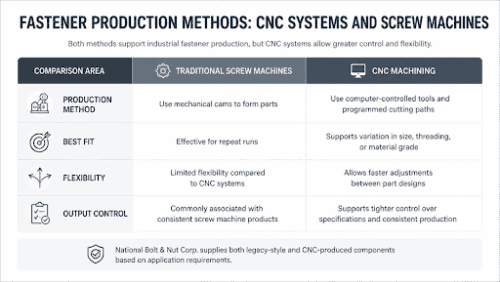
Traditional screw machines remain part of legacy production methods in some facilities. These systems use mechanical cams to form parts and are commonly associated with screw machine products. While effective for repeat runs, they have limited flexibility compared to CNC systems.
CNC machining allows faster adjustments between part designs and supports tighter control over specifications. This shift has expanded production capability for fasteners that require variation in size, threading, or material grade.
Screw Machine Products in Industrial Supply
Screw machine products continue to serve sectors such as automotive, electrical assemblies, and machinery production. These components are typically high-volume items produced with consistent geometry.
CNC machining has improved how these products are manufactured by reducing setup limitations and supporting shorter production runs without sacrificing consistency. National Bolt & Nut Corp. supplies both legacy-style and CNC-produced components based on application requirements.
Domestic Fasteners and Supply Reliability
Domestic fasteners play a key role in maintaining stable supply chains for manufacturing and construction projects. Local production reduces lead times and supports material traceability and compliance requirements.
For buyers, sourcing domestically produced fasteners helps reduce delays tied to overseas logistics and improves response time for urgent requirements. National Bolt & Nut Corp. supports this need by supplying domestic fasteners for industries that operate on strict schedules and production deadlines.
Let’s Bolt You In with the Right Solution
CNC machining continues to support fastener production through repeatable, controlled manufacturing processes. From CNC turned parts to screw machine products, these methods supply components used across critical industries.
For sourcing requirements that include domestic fasteners and precision-engineered components, National Bolt & Nut Corp. provides industrial supply solutions aligned with production and maintenance needs.
Frequently Asked Questions (FAQ)
Why is CNC machining important in modern fastener production?
CNC machining allows fasteners to be produced with high repeatability, tight tolerances, and consistent quality. This is especially important for bolts, screws, and pins used in mechanical systems where failure is not an option.
How does CNC turning contribute to fastener manufacturing?
CNC turning shapes raw bar stock into cylindrical fastener components such as shafts, pins, and bolt bodies. This process ensures uniform diameter control and smooth surface finishes before threading or final processing.
What makes CNC fasteners different from traditional screw machine products?
Unlike mechanical screw machines, CNC systems use programmable controls, allowing faster design changes, more complex geometries, and improved precision. Screw machine products are still used for high-volume runs, but CNC offers greater flexibility for modern production needs.
How are threads created in CNC-machined fasteners?
Threads are produced using CNC thread cutting or rolling processes based on standardized profiles like metric or unified threads. This ensures consistent engagement and load distribution in assembled components.
What role does material selection play in CNC fastener performance?
Material selection determines strength, corrosion resistance, and durability. Common choices include carbon steel, stainless steel, and alloy metals, depending on whether the fastener is used in structural, automotive, or industrial environments.